



Numerology
The Mask the World Sees!
Outer Expression




About
The Outer Expression, also known as the “Personality Number,” is the sum of the consonants in the name on your birth certificate, reduced to a single digit. For the Outer Expression, we included the Master Numbers of 11 and 22. The letter Y is included in the calculations as a consonant if the name contains vowels, eg Mary, Suzy, Yasmine, Yolanda, Yves, Yousef. Vowels are the ‘soul’ of a name; consonants are the structure that shapes or contains the ‘soul’ of a person. The Outer Expression describes the obvious traits that other people see - the impressions made before a person gets to know them (and the deeper desires). The Outer Expression is the ‘wrapping’, or the 'mask'. These interpretations are based on the Pythagorean Alpha Numeric Chart below:



Tips
Remember - the point of numerology includes not only self-discovery and awareness, but recognising and creating an internal balance, peace and harmony. The mask we wear (or how others perceive us) is relevant in that regard - is this the image we choose to portray to the world? More importantly, does the expression balance against the ruling number, Day Number, and the Birth chart (including arrows? What might seem like an oppressive number for Outward Expression may, in fact, balance an introverted Soul Urge, Ruling Number, and so forth. Nothing in Numerology should be interpreted as ‘Stand Alone’.

Calculating the Outer Expression
While many numerologists say we should use the full name on the Birth Certificate (in this instance: Robin Joseph Smith), others believe you should calculate the chosen names or diminutive name versions. Chosen names and diminutives can change the way a person appears to the world (or how others perceive them). As the examples below show, when we use the name on the birth certificate, the outer expression of ‘Robin Joseph Smith’ resonates with the number 3 (a charismatic, likeable individual). The diminutive forms of Robin, while at a glance appear sociable and easygoing, are actually more likely to carry cautions against being superficial; if ‘Robin’ wants to achieve success with their goals, they will need to apply themselves with determination. If Robin William Smith existed, he might decide to stop using the diminutive forms of his name (of course, this decision would mean he’d need to look at the other aspects of his birth, such as ruling numbers, day numbers, and the influence of numbers on the birth chart and whether there are arrows to be considered before deciding on a name change. After analysing and scrutinising the other factors, you may determine that the diminutive helps balance other individual traits in a positive, helpful way.
Steps:
Write your full birth name (the name on your birth Certificate - experiment with the other diminutive, pet or nicknames).
Identify all consonants.
Convert each consonant to its number value.
Add the consonant values for each name separately.
Add the subtotals together and reduce to a single digit, or stop at 11 or 22.
Example: ROBIN JOSEPH SMITH
(SUM OF CONSONANTS ONLY).
ROBIN: R (9)+O+B(2)+I+N(5)=16→ 1+6=7
JOSEPH: J(1)+O+S(1)+E+P(7)+H(8)=17→ 1+7=8
SMITH: S(1)+M(4)+I+T(2)+H(8)=15→ 1+5=6
Total: 7+ 8+ 6= 21→ 2+1 = 3
The outward expression of Robin Joseph Smith is a 3
Example: ROBBIE JOSEPH SMITH
ROBBIE: R (9)+O+B(2)+B(2)+I+E=13→ 1+3=4
JOSEPH: J(1)+O+S(1)+E+P(7)+H(8)=17→ 1+7=8
SMITH: S(1)+M(4)+I+T(2)+H(8)=15→ 1+5=6
Total: 4+ 8+ 6= 19→ 1+9 = 10
The outward expression of Robbie Joseph Smith is a 10
Example: BOB JOSEPH SMITH
BOB: B(2)+O+B(2)→ 2+2=4
JOSEPH: J(1)+O+S(1)+E+P(7)+H(8)=17→ 1+7=8
SMITH: S(1)+M(4)+I+T(2)+H(8)=15→ 1+5=6
Total: 4+ 8+ 6= 19→ 1+9 = 10
The outward expression of Robbie Joseph Smith is a 10
Remember - the point of numerology includes not only self-discovery and awareness, but recognising and creating an internal balance, peace and harmony. The mask we wear (or how others perceive us) is relevant in that regard - is this the image we choose to portray to the world? More importantly, does the expression balance against the ruling number, Day Number, and the Birth chart (including arrows? What might seem like an oppressive number for Outward Expression may, in fact, balance an introverted Soul Urge, Ruling Number, and so forth. Nothing in Numerology should be interpreted as ‘Stand Alone’.
Outer Expression Numbers
Outer Expression 1
This expression occurs only when there is a single consonant, either a J or an S. For example: Jay or Sai. These people need the freedom and flexibility to work at their own pace to gain satisfaction and self-confidence in their physical pursuits. They are best suited to solo activities in the form of work /sports. Bearing in mind that the outer expression is the mask, these people project an image of leadership (even if they lack confidence). Others may perceive this image as domineering (bullying/over-assertive), or as someone who encourages others toward an outcome (initiating an action or project), as though a more subtle leadership style of competence and reliability. It is usually a process of growth and maturity where, in the younger years, the person tends to overcompensate as a means to get things done (and usually because they think their way is the right way and coerce others into doing it the ‘right way’), or as an easy leadership flow, where it ‘just happens’ because, as the person matures, they portray a steadiness and balanced leadership style- knowing when to assert and when to let things take a natural process, with them guiding quietly at the helm.
Outer Expression 2
People with the outward expression of a 2 (where consonant totals are either 2 or 20) prefer to work in a group. They lean toward happy activity, seeking fun surroundings and people to be with. They perform best in happy, organised groups, where they feel most valued and fulfilled. They are sensitive individuals and usually pick up on the ‘non-verbal cues’ and body language of people around them, and respond to what is happening. They are warm and approachable, and people feel comfortable sharing their problems with them; they can also be diplomatic and soothe any distress the person is experiencing. Bearing in mind this is a ‘mask’, people with a 2 are often underestimated in their own ambitions (and their emotional state and inner strength). Whether they work in a group or not, the 2 tends to prefer working with people and making a positive emotional difference, so they are often found in the fields of psychology or health. The problems others may have with the 2 are that they have failed to recognise that the 2 is not passive - or weak, because they have compassion and diplomacy. Still, they are quietly strong and perfectly able to lead and inspire (in the right environment for them), but they would prefer someone else to lead if the leader is competent. They will step into leadership roles when needed.
Outer Expression 3
These people enjoy entertaining others and enjoy being the life of the party. People with this soul urge have a consonant sum of 3, 12, 21 or 30. They are usually quick-witted and have a positive outlook on life. As social people, they are extremely responsive to their environment (partly because they like to perform to a crowd), so they need to be very discerning about who they associate with and the type of ‘fun’ they participate in. They are the people who enter a social environment and lighten it up immediately, and gain joy from making other people happy. However, until they mature, this happiness can be quite superficial, scattered, and a ‘social butterfly ’, and they can at worst appear self-indulgent and scattered. If they have experienced trauma, then they may appear pessimistic and even joyless. They usually rely on humour or charm during conflict as a means of defusing any tension. Career paths for the 3 are those that involve communication.
Outer Expression 4
The sum of consonants is 4, 13 or 31. People born with this expression tend to be the ‘doers’ and are practical. They like to work with their hands or feet. This makes them good artisans or sports people. Most people with an outward expression of 4s are perceived as consistent, steady, and competent. The positive 4 portrays a confident and measured communication style. Older 4s have developed a good verbal filter. They have a methodical approach that attracts people with logical, rational problems that need fixing (they would know better than to approach them for help with emotional chaos - because the 4 has little patience for them). These folk are the ones that work well with anything that involves planning and reviewing - things like financial documents, or business planning (especially first stage, foundational concepts). The 4 usually has strong boundaries that can either protect or imprison (basically aid ease of social interaction - or wrap around protection for conditions such as social anxiety). They can be (until they mature) quite stubborn and rigid in their thinking, and inflexible - holding onto redundant systems and methods that are no longer practical. The 4 tends to be a ‘worker’, so they rarely show the strain and fatigue from the work (which can be deceptive - and invite more work when they are already struggling). Work they are suited to and career pathways are where attention to detail is valued, or foundational type professions - engineering, project management, finance, or architecture. However, they like to get their hands dirty, so they often work as skilled tradespeople.
Outer Expression 5
Sum of Consonants is 5, 14, 23 or 32. These people need a lot of physical space and would feel trapped in an office-type environment. They need to be surrounded by responsive people who lack inhibition. This is because they often feel misunderstood due to their own suppression and inhibition of self-expression (sometimes because of shyness or a lack of self-confidence). When they are around other people who suppress their personality and sense of self, they can become frustrated. The people with the outer expression of five basically have little to no boundaries - they are sensory people, and they are constantly seeking change as part of feeling alive. They struggle to stay in the same job for more than a year, and if they do, it's because the job keeps them interested and stimulated. (It may involve a lot of change and lack predictability). They project restlessness and an energy that reflexively draws you in and grabs your attention. They are the type of people who notice changes in the environment - small and large. They tend to be a bit of a ‘free spirit’ and ‘march to the beat of their own drum’, and often travel to new locations to feed their incessant quest to stimulate their intelligence. They appear self-sufficient and independent, without needing to rely on other people for fulfilment. In fact, they may even appear to have relationship commitment issues. Routine is boring and mundane, and while people may fall hard romantically for the 5, it is not usually reciprocated until later, once the 5 has overcome restlessness and developed faithfulness. They become one of the most faithful partners in numerology.
Outer Expression 6
This expression occurs when the sum of the consonants totals 6, 15, 24, or 33. Their energy focuses on home. They need to maintain balance to avoid overindulgence; attending to domestic and family needs is good, but taken to the extreme, it can negatively affect them and other family members, creating a risk of pampering that blocks self-growth and independence. They tend to project competence and harmony. They are comfortable sharing personal information (and often overshare), which makes the people around them feel safe sharing personal information as well. They are approachable and socially at ease. Usually, they prefer colours that are ‘soft’ or even pastel, but the colours have harmony (in clothes and their choices of furnishings, fabric, and even wall paint). Their homes also carry this harmony (even if the house is not immaculate, it will feel comfortable and be a place where visitors can relax). They are there for friends and colleagues (and family) when they need to vent and be listened to. An asset and a flaw if it is taken too far is their capacity for giving, usually time (or material gifts), and often they overgive and are overagreeable - saying yes to all requests. They are good organisers and helpers.
Some 6s become a doormat because they sacrifice their own needs and give until they are drained. Other times, once they become aware of the overgiving, they stop and totally withdraw. Instead of projecting generosity, they appear aloof, unavailable, and unloving, projecting coldness instead of warmth. Their personality hasn’t changed; their behaviour has. As they overgive, they can go through an identity crisis once they reach maturity. Career-wise, they can be leaders, but this isn't their usual choice, as they would rather be part of the team than lead it. They prefer the planning and organisational aspects of teamwork and supporting other team members to help the team function well. They work well in areas such as counselling, therapy, teaching, or caregiving.
Outer Expression 7
Outward Expression 7 is for people whose names have a consonant sum of 7, 16, 25, or 34. They learn best by doing and like to figure things out on their own. They will listen to advice but may not act on it, because they feel compelled to test the theory themselves. Once they test a theory, they happily share what they learn with others. They find self-satisfaction in discovering new approaches. Although they seem open and friendly, others rarely see beneath the surface, so they carry a mysterious air. They come across as thoughtful, self-controlled, and intelligent, with clear boundaries, and they are careful about what personal details they share. This creates a duality: warm and approachable yet distant, which can lead to perceptions of arrogance or aloofness. They carry an air of self-confidence and are comfortable with themselves, and this attracts people.
Because they aren't trying to impress anyone and tend to research subjects that interest them, they are often very knowledgeable but keep it hidden. They do not feel the need to talk themselves up; however, they will share their knowledge, beliefs, and opinions when asked. You will notice a pause before they respond, because they are processing and giving a deliberate, thoughtful answer. When it comes to sharing feelings, emotions, and personal information, they are more likely to withhold them. Integrity matters to them, and once they commit to someone or something, they stick to it. Children with an Outer expression of 7 can be misunderstood because they like to watch rather than join group activities. In their careers, they are drawn to roles that involve depth, analysis, research, technology, philosophy, or specialised work, where they can focus and where the process matters more than results or performance numbers. They can be leaders but are usually not managers; instead, they add value as team members because of their expertise. In teams, they might be overlooked because they are quiet and prefer to stay in the background. They like to work alone so they can focus deeply on their tasks. Of all the numbers, 7 is most likely to keep up a strong front. Most people only see the surface, and unless someone is very close, they may never see the real depth.
Outer Expression 8
An Outer Expression of 8 occurs when the sum of consonants is 8, 17, 26, or 35. These people have a strong desire for independent expression and act as individuals. They dare to be different and assert strong personalities. They know that personal and self-development means thinking outside the box. It conveys a sense of command and power. Often found among executives, these people have a commanding presence, even if it is through their voice, and they recognise they drive their own destiny. Justice and fairness are core to their personality. People perceive them as having everything figured out, even when they haven’t, because of the competence they project and their capacity to handle responsibilities.
While it can be associated with financial or career success, they recognise that actions result in consequences and reactions, and that life is transactional and reciprocal. They like to reward people when they feel it is warranted, even if it is giving a tip or a bonus to a worker; however, they have little tolerance for imbalance or dishonesty. Usually within the professional setting, they are very trustworthy, and their demeanour encourages people to feel safe investing with them. Fairness and justice work both ways, and if they perceive someone as dishonest or unfair, or that rewards have been given unwarrantedly, they will be quite harsh. The 8 keeps a tally of what has been given and received, and this can be problematic in intimate relationships. The 8 is not afraid of commitment, and when they commit, they go in wholeheartedly. However, if a relationship breach or tension occurs, they can withdraw because they do not do mediocre. Even if the withdrawal is only emotional, it will be deeply obvious to the other parties. Socially, they can influence others with ease because of their compelling presence. People may see them as ambitious or money-motivated, and they can be orderly and commanding in their interactions. They are usually perceived as strong, whether they are or not. They have little time for small thinkers and can seem intimidating. They tend to attract situations that require leadership and decision-making, and the 8 is not afraid to be accountable. Often found as business owners or managers, with extreme peaks and reversals—financial success and then financial lows. Same with emotional: all or nothing. Underbalanced 8s can lack financial or business success and detach from material reality. The 8 carries spirituality with it, and sometimes they will act spiritually superior and develop a poverty mentality. Other times, when the 8 lacks financial success or experiences a financial drought, they realise this was their personal choice for reasons they can justify to themselves, for instance, family first. Workwise, they are often found in law, finance, executive or corporate roles, or project management.
Outer Expression 9
An Outer Expression of 9 happens when the sum of the consonants in a person's name is 9, 18, 27, or 36. People with this number often get caught up in serious parts of life, which can sometimes look like sadness or loneliness. They have a strong sense of helping others. The number 9 is known as the Visionary, and people with this expression usually have a broad outlook. They can see all sides of an argument and understand the causes and effects of difficult situations. They notice patterns and are often interested in social justice. This can show up as an interest in politics, philosophy, history, or culture, but they also care about individuals as well as groups. Their big-picture thinking gives them an intuitive advantage, and they are empathetic to others and their feelings. Because they understand patterns and consequences, they can often predict what will happen next. Others may see them as having an 'old soul,' even when they are young. People trust them and feel comfortable sharing emotions and problems, knowing they will get good advice. Nines are passionate about activism and are often found working in humanitarian or social justice organizations. They are thoughtful and like to share what they have learned. Many work as teachers, counselors, spiritual or religious leaders, journalists, or in international organizations. The downside for a 9 is that if they face too many challenges at once, they may become depressed or pessimistic. It can be hard for them to regain a positive outlook, and it often takes real effort to recover.
Outer Expression 10
Sum of consonants that total 10, 19, 28, or 37. This expression cautions against being too flippant or superficial. It carries adaptability and the ability to adjust to change. Balance a fun perspective with responsibility, and do not take each new event too lightly. Understand the opportunities presented, and fulfil the life path. It takes determination to achieve life goals and find your role in life. People with an outer 10 can often be perceived as arrogant and emotionally detached (especially if they are focused on the social aspects of life). Often, they appear successful even if they are not, projecting a veneer of self-sufficiency. This is largely because they are ambitious (they want quality material things in life) but are not necessarily prepared to work hard for them, because for them, life should be more than work. Often, their success comes through their social connections. However, if they do not learn to balance social /material efforts, they may ‘lose their wealth’ in later years and have to start over.
Outer Expression 11
The sum of consonants totals either 11 or 29. This expression reflects balanced spiritual and emotional expression. It brings a longing to instil harmony into the environment and the people within it, emotional control, and a heightened understanding of life and its processes. Full happiness comes only when the individual follows this path. Others typically perceive them as sensitive, diplomatic, and willing to cooperate. They often carry nervous tension, which can make them unpredictable and jumpy. Their work pathway often includes intuitive gifts, whether in spiritual or creative practice, or in human service roles. It can take years to develop confidence in these gifts, and they may struggle in relationships and social connections because of trust issues. People around them may see them as either exceptionally deep or exceptionally distant, and this can cycle for years. They project an air of knowing, as if they can see past the undercurrents of people and situations, although this is not always the case. Others feel comfortable sharing their problems with them as they work toward solutions. As children, they are extremely sensitive and may struggle to rationalise their feelings and manage emotional reactions. They can also show an alertness that others perceive as consciousness or shyness. As teenagers, they may become more emotional and sensitive as they learn the mastery associated with the number. By midlife, in their thirties or forties, stability and clarity set in, and they begin to work with and manage the gifts of the 11, learning to channel nervous tension and energy into positive pursuits. Mastery comes later, when they learn to use and trust their intuitive gifts, perceptions, and judgements.
Outer Expression 22
This number occurs only when the consonants total 22. It lends itself to exceptional organisational abilities, which suit business and commercial enterprises. If the person's ruling number is 4, 8, or 22/4, they may fixate on money-making ventures to the point of obsessiveness. They need to balance this tendency, or it may negatively affect other aspects of life, such as relationships. To balance the material aspect, they are advised to support charities and volunteer with disadvantaged groups. A person with this expression should find a cause they are passionate about and make it a permanent hobby. This could be environmental concerns, working with children, animals, or anything where they donate time, even if they serve on a committee or board. When people meet them for the first time, they tend to feel a ‘presence’. They think on a different scale than everyone else, and something about them feels unusual. The exterior of the 22 is both practical and visionary. They have a big dream or vision, and their approach is grounded and concrete. This duality, and the capacity to do both, makes the 22 persona rare. People trust them instinctively, and from a young age they absorb others' confidence. They are perceived as reliable, with attention to detail and a methodical approach to tasks. They will instinctively create systems for their approach. However, while they build a vision, the reality is that, as with physical labour, they have to rest, so they have moments of extreme activity followed by phases of exhaustion. The 22 often suffers from physical weakness or fragility, a manifestation of illness from their mind's busyness. They can become burned out and are susceptible to exhaustion. Productivity comes in bursts, and without time management, it can fizzle. Where the 11 struggles with nervous energy, the 22 struggles with physical energy and depletion and has had to develop self-discipline to maintain the physical ‘vehicle’. Often, particularly in group efforts, the 22's contributions are overlooked because they care less about ego and more about the outcome, especially when it involves a collective result, such as working on projects for systemic change within government to improve outcomes for vulnerable people. This is largely because the 22 projects have an air of service, and people realise that the vision they are building is for more than just themselves. They may work on the project for decades, experiencing setbacks year after year and ingratitude. A constant temptation is to redirect that energy and effort toward personal gain, which creates real dissonance because the 22 energy denies individual welfare in favour of the collective. When they focus on personal gain, they go against their number's highest expression. The 22 is a philanthropist and can struggle to stay motivated when they feel invisible and when the public doesn't recognise or include them in feedback on their efforts.
They can remain motivated without recognition if they feel their efforts are valued and make a positive difference. They may move from job to job until they find work and a career that gives them professional scope for reform. People often see them as serious and ambitious. Often, they land on their feet at work, with doors opening. They can lose their creativity if they get absorbed in the details and become micromanagers, which does not align with the vision; their job is to hold the vision while others fine-tune it. They must guard against burnout and make time to reflect, not only to recuperate but also to acknowledge their achievements, because they often are not aware of how far they have come with the vision. A schedule and planner help. They let them check boxes, measure success, identify when to redirect or take a different approach, and establish what is working and what is not. In relationships, they struggle to find suitable matches because they can be overwhelming. When they are working, it absorbs them, and relationships become secondary. The 22 craves independence but, at the same time, desires relationships, but they become ‘difficult to love’ because they are so enthralled by the vision. When it comes to partners, the right person who is happy to fit in and support the vision is hard to find. They need someone to handle the mundane and give them the freedom to fulfil their outer expression.

Quick Links
DAY NUMBERS
NAME NUMEROLOGY
NAMES & NUMBERS PT 2


RULING NUMBERS
INTRODUCTION
THE BIRTH CHART
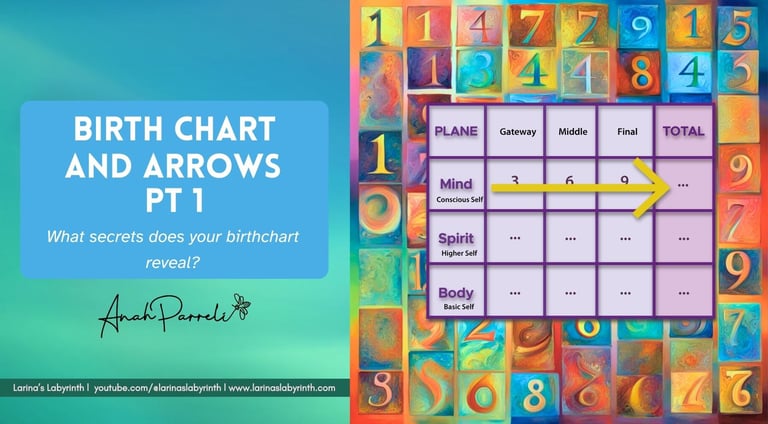
ARROWS & THE BIRTH CHART

Curious for more?
Looking for more videos?
Click below to discover a collection of engaging content on the Numerology Play list on Youtube!




Have any questions?
If you would like to buy me a cuppa as an exchange for sharing with you, the information I have gained over the last 25 years - it would be gratefully received.
If you have any questions about numerology - start or join a conversation at YouTube on either the Sunday Yarning videos or under any of the many Videos about numerology and the numbers!
© 2025 Copyright Larinas Labyrinth
Mission
To support people to raise their levels of awareness, and develop themselves to the fullness of their potential through the access to provision of information and metaphysical product and other self help strategy.

Useful Links
Policies